
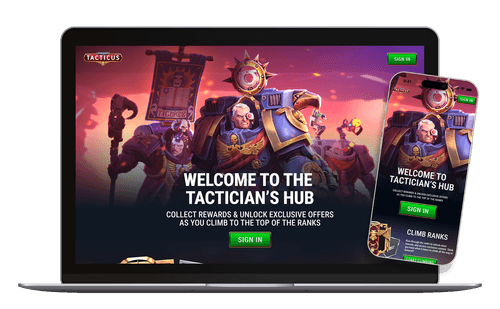
Warhammer 40,000: Tacticus - Webstore & Loyalty
Directing and Designing the Tacticus DTC Ecosystem
Objective: To architect a seamless Direct-to-Consumer (DTC) webstore that maintains absolute brand parity with the in-game experience, integrated with a premium loyalty program tailored to maximize engagement and lifetime value for high-value players.
Measured Impact:
- 7x increase in daily webshop revenue after loyalty launched
- +60% first-time purchases on day one
- 75% repeat purchase rate on the webshop
- 4x DTC wallet share growth
- Refund rate below 0.1%


1. Safeguarding IP & Game Experience Fidelity
For a beloved IP like Warhammer 40,000, brand accuracy is non-negotiable. I moved away from rigid templates and instead implemented a Direct-Sync Architecture.
- Dynamic catalog: Allows the studio to update both platforms simultaneously, eliminating the need for separate asset management or manual catalog parity.
- Creative Control: The studio maintains total control over their brand. When an asset updates in-game shop (eg. VIP pass), the web store adapts instantly, preventing the "distorted" or "off-brand" look common in third-party D2C portals.
- Layered Asset Rendering: To solve the "mobile vs. desktop" aspect ratio problem, I separated asset layers (backgrounds, frames, and foreground sprites). This allows product cards to crop dynamically without distorting the character art, preserving quality and scalability.
- Single Source of Truth: Integrated shared purchase limits and segmentations, ensuring that limited-time offers and player-specific "VIP" deals remained consistent across all devices.
2. Strategic Loyalty & Web-Native Incentives
The webstore isn't just a shop; it’s a high-value destination. I designed a Tiered Loyalty Program that rewards players for bypassing app stores.
- Tiered Progression: Designed a VIP system where player engagement translates into exclusive web-only rewards, increasing the "switching cost" for players to move back to standard app stores.
- Incentivizing the Migration: By offering superior value (bonuses, exclusive bundles) on the webstore, we converted the lower urgency of web browsing into a high-intent "hub" for power players.
- Unified Reward Logic: Integrated purchase validity checks with Snowprint’s servers so that web-earned bonuses and purchases sync instantly in-game, creating a single, cohesive player identity.
3. UX Transformation: Game UI to E-commerce Logic
App native design often fails on the web. I designed a frictionless high-value experience.
- E-commerce Product Pages: In-game, players use tiny "i" buttons for tooltips. On the web, the info tooltip is replaced with a dedicated Product Detail Page. This familiar e-commerce pattern allows for clearer drop-table data and better legibility on desktop.
- Intent-Based Design: Recognizing that web users are "browsing" rather than "playing," I optimized the layout for clarity and comparison rather than impulse clicks, leading to a 75% repeat purchase rate.
“Stash made it clear from the outset: IP considerations were fundamental. Their tech and design ensures the control always remains in our hands, safeguarding our brand fidelity.”
Alexander Ekvall, CEO at Snowprint Studios

Key Design Challenges & Solutions
1. Balancing High-Value Incentives with Game Economy Stability
- Challenge: Designing a Tiered Loyalty Program that offers aggressive enough incentives to move players away from App Stores without devaluing in-game currency or breaking the game’s economy.
- Solution: Implementation of a "Value-Add" rather than "Price-Cut" strategy. Instead of just discounting, the webstore offers exclusive "web-points" and tiered bonuses that reward long-term commitment, ensuring the D2C channel feels like a premium club rather than a bargain bin.
2. Translating "Urgency" Across Different Mediums
- Challenge: In-game purchases are often driven by immediate needs (e.g., failing a level). On the web, that "contextual urgency" disappears.
- Solution: I shifted the UX focus from Impulse to Intent. I designed the Webstore layout to prioritize "Comparison and Discovery," using e-commerce patterns like detailed product pages and loyalty progress bars to give players a new, different reason to convert outside of active gameplay.
3. Maintaining IP Fidelity in a Fluid Web Environment
- Challenge: Most web-store builders use static screenshots which look blurry or "stretched" on 4K monitors or ultra-wide browsers.
- Solution: I used a Layered Vector/Sprite Approach. By architecting product cards where the background, frame, and character sprite are separate assets, the UI remains crisp and perfectly composed regardless of the user's browser dimensions or zoom level.
4. Designing a Frictionless "Cross-Platform" Identity
- Challenge: Players find it jarring to log into a website and see a catalog that doesn't reflect what they just did in the app (e.g., seeing an offer for a character they just unlocked).
- Solution: A real-time State-Sync logic. By hooking the Webstore directly into the game’s "Single Source of Truth" database, we ensured the web experience mirrors player progress instantly, graying out owned items and updating VIP tiers in real-time to maintain a "Unified Player Journey."
5. Strategic Onboarding
- Challenge: High churn during the transition from the game to the webstore due to a lack of context regarding loyalty incentives.
- Solution: I architected a contextual onboarding flow that maintained visual and mechanical parity with the game's native tutorials. This seamless integration ensured players understood the value of the DTC store immediately, resulting in significantly lower churn and a faster adoption rate among the high-spender segment.
 Visit Tacticus Webshop:
https://hub.tacticusgame.com/